
Two of Parts (UX and UI)
Click here to see my Narrative work on this project.
Engine: Unreal Engine 5
Team Size: 9 people
Tools: Figma, UMG, UE Blueprinting, Trello
Role: UX Lead and Narrative Lead
Skills
-
Medium Fidelity Wireframes
-
High Fidelity Wireframes
-
UI Graphics
-
Animating UI in UMG
Duration: 14 Weeks | Jan 2025 - Apr 2025
Two of Parts is an academic game project developed over one semester with an interdisciplinary team during my Sophomore year at DigiPen.
This page details the user experience design work I did on this project, including medium and high-fidelity wireframes and rapid design iteration.
Scroll down to see my process!
Project Overview
Two of Parts is a 3D first-person blackjack simulation set in a Cyberpunk-meets-Wild-West future. You play as a grief-stricken robotic cowboy trying to win back the parts of his lover from a shady casino.
The interdisciplinary team consisted of 9 developers: 5 artists, 3 game designers, and 1 musician. I was the Narrative and UX lead.

Blackjack UI
With our main gameplay loop revolving around Blackjack, I had to make sure that it looked good to play and felt good as well.


First Passes of Blackjack UI
In the early stages of development, our attention was primarily on core mechanics, but I still took time to map out how the UI should sit on the screen.
The first photo is our first milestone. At that point, we only had the basic card-drawing system in place with no betting features, so the interface was much simpler.
The second photo is our second milestone. By then, the full Blackjack system had been implemented, including the betting, score, and card-drawing UI. The layout was functional and readable at this stage, and I planned to continue refining it in later milestones.
Final Passes of Blackjack UI
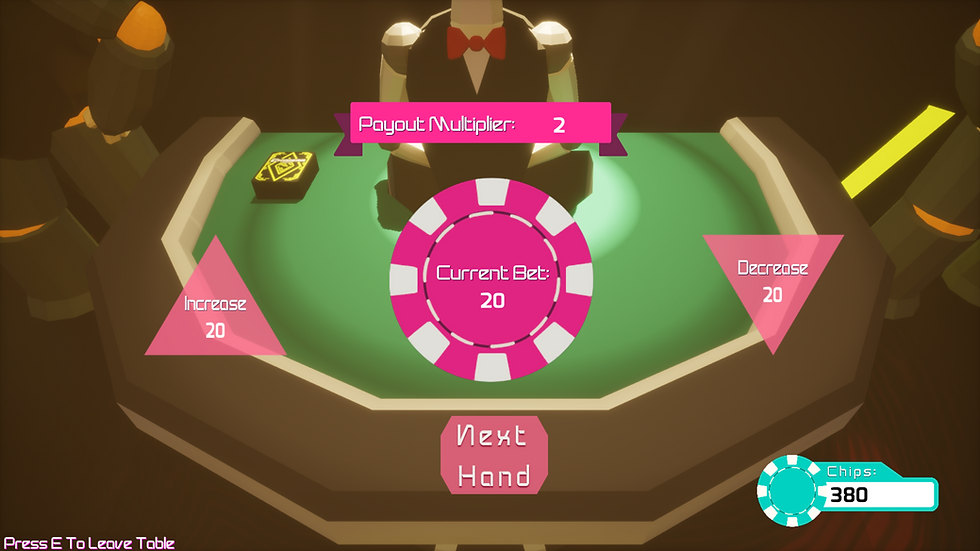
The fist image is the Betting UI. I kept a consistent poker-chip motif throughout the UI and limited the palette to neon blue, pink, and yellow, which are the dominant colors of the level’s environment. The center chip displays the current bet, which players can raise or lower. Higher tables feature higher base bets, but they also offer stronger multipliers.
The second image is the Blackjack UI. Players can hit or stand, and both their score and the dealer’s score are displayed clearly in their respective areas. When the dealer rotates through his randomized barks, his dialogue box appears at the top of the screen.

Blackjack UX
With the UI in place, I shifted my focus to the game feel of playing blackjack.
Research
To better understand the appeal of gambling, I researched why players keep engaging with these systems and how we could capture a similar sense of excitement in our game.
I focused particularly on slot machines, which rely on bright lights, bold visuals, and distinctive victory stingers to create a moment of payoff. Wins feel big and rewarding, while losses are presented more subtly so players aren’t immediately discouraged. This balance helped inform how we approached feedback and player motivation in our own design.
Credit: Vegas Matt
Inventory UI
With the project’s narrative constraints, I needed to make every line of dialogue count. I organized all dialogue into three clear functions: Tutorialization, Ambience, and Motivation, to keep the writing focused and effective.
Tutorialization
The first sheet covers the bouncer’s dialogue. As the player’s initial point of contact, he sets the tone and shoos them away towards the side alley, where they’ll meet Mr. Tortorial.
The second sheet contains the tutorial sequence with Mr. Tortorial. He walks the player through a no-stakes Blackjack round using an abandoned dealer-bot, offering clear guidance while also giving players the option to skip the tutorial.
Since our target audience consists of casual Blackjack players, I didn't want them to get bogged down by a forced tutorial.
Ambience
The main level, the casino, is a sprawling, three-story space, which meant there was a lot of atmosphere to fill. I went back and forth on making it abandoned, but ultimately chose to keep it bustling and lively.
I wanted the player to feel a subtle sense of desperation: while they’re locked into their own frantic cycle of gambling, everyone else around them seems unbothered. That contrast reinforces the tension at the heart of the experience.
To support that tone, I wrote a variety of barks for patrons and bouncers throughout the area, which play at random whenever the player walks near them. This layering of voices helped bring the casino to life and deepen the player’s emotional context within it.

Motivation
The dealer’s barks became the narrative anchor of the experience, directly tied to the core gameplay loop.
I shaped the dealer’s voice to be snarky and slightly condescending. By positioning the dealer as an “antagonist,” the dialogue pushed players to stay engaged, chase another round, and prove the dealer wrong.
That approach proved effective in testing. Throughout multiple sessions, I watched players react to the dealer’s lines with frustration, laughter, and determination. The taunts did exactly what they were designed to do: motivate players to push back and keep playing.
In - Game Artifacts
Around the midpoint of development, we began playtesting, and it quickly became clear that many players were unsure about what was happening narratively. To address this, I created a series of in-game artifacts that the player receives each time they purchase one of Jack’s parts from the shop.
These data entries, shown on the left, were designed to be brief and varied. I didn’t want players to feel like they were collecting endless journal pages, so I mixed the formats, using letters, voice notes, and journal fragments to keep the experience fresh.
The first two entries appear when the player spawns, offering immediate context about who they are and how they ended up in this place.
Because the protagonist never speaks, these artifacts became a key means of expressing his personality. Through them, players learn about his relationship with his family, his husband, and the emotional lens through which he views the events of his life.


Reflection
This project turned out to be incredibly insightful. It was my first time working on a large-scale game with an interdisciplinary team, and it taught me a lot about how different pipelines, art, audio, and design, intersect and depend on each other. We definitely faced communication challenges early on, simply because none of us had worked together before, but after long work sessions and genuine team-bonding, we found our rhythm. Our workflow became not just smoother, but genuinely collaborative.
I also struggled at first with delivering a meaningful narrative within such a tight scope. Leaning on dialogue and data entries ultimately helped me keep the asset load small while still giving players the clarity and emotional context they needed.